
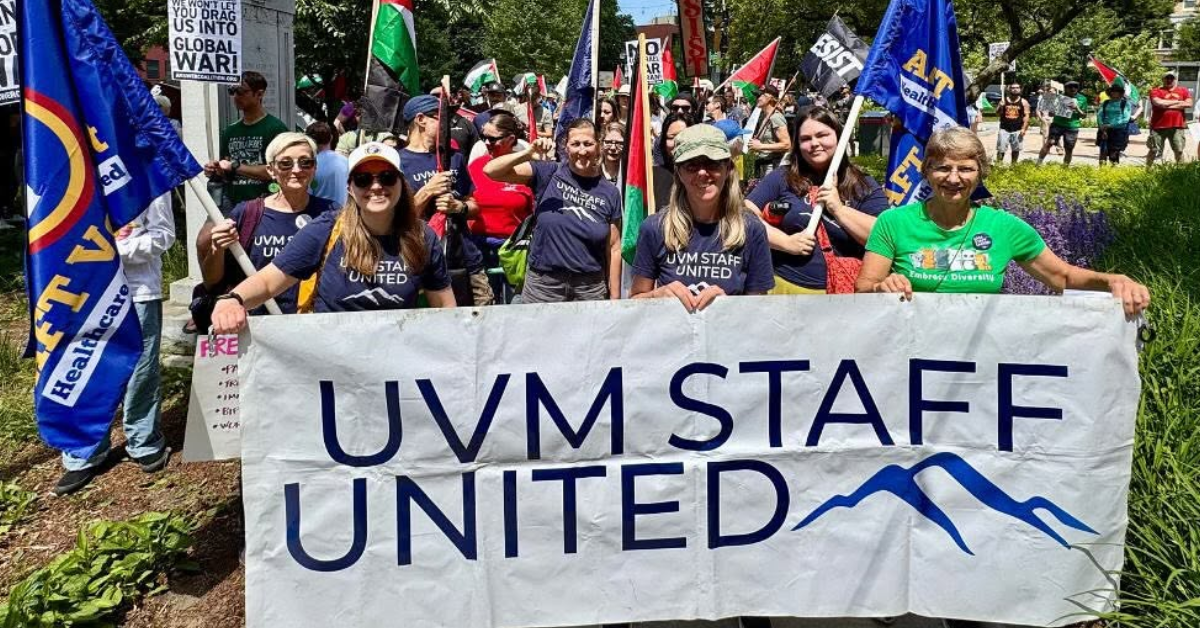
By Kolby LaMarche
The vote, conducted over roughly a week, does not mean an immediate walkout but it has given bargaining teams for UVMMC Support Staff United and the Vermont Federation of Nurses and Health Professionals the power to call a strike after providing the legally required 10-day notice.
No strike date has been set and union officials said they intend to give hospital administrators one more chance to return to the negotiating table before issuing that notice.
The two groups have bargained jointly since April over separate but parallel contracts covering a wide range of roles, including licensed nursing assistants, technicians, phlebotomists, housekeepers, and other essential non-nursing staff.
Their previous contracts expired in mid-August. Nurses at the medical center, who belong to a different bargaining unit under the same federation, are not part of this dispute and continue working under their own agreement.
Resident physicians recently settled a separate contract.
Union representatives framed the authorization as a defensive step to protect patient safety rather than a desire to disrupt care. “We want to give every single possible opportunity to come to a deal. The 82% that voted for a strike, it’s not because they want to strike, we’re doing this to protect patient care and obviously a strike will impact patient care,” said Jacob Berkowitz, president of UVMMC Support Staff United.
The core disagreement centers on staffing. Union leaders say safe staffing has been their top priority from the start of talks, ranking above wages or benefits.
They argue that chronic understaffing has become normalized and that recent workforce reductions have made the problem worse. The University of Vermont Health Network eliminated 142 positions in June and announced another 199 cuts in September, citing a major budget shortfall.
Some of those reductions affected clinical and support roles, according to union accounts, and included the closure of a general medicine floor.
Workers contend that existing contract language requiring shared decision-making on staffing plans, enforceable timelines, and certain incentive-pay provisions when units are short-staffed is essential.
They say the hospital’s latest proposals would eliminate those enforceable timelines, give management unilateral final authority over staffing plans, and limit or remove support staff participation in the process that technical staff and nurses currently share.
Union members described the hospital’s “last, best and final” offer, presented last week, as containing multiple “take-backs” that would leave patients in less safe conditions, they said.
Nicole DiVita, president of the Vermont Federation of Nurses and Health Professionals, put the choice more starkly after the final offer, telling Vermont Business Magazine “management was very clear in bargaining yesterday that we could either accept worse protections for our patients, or we could move towards a strike.”
Wages form a secondary but significant point of contention.
According to hospital figures, the median hourly wage for support staff was $27 in 2025 and $36 for technical employees.
Management has proposed a 10 percent wage increase spread over three years at a cost of roughly $20 million. Union proposals, the hospital said, would cost about the same amount but deliver the raises in half the time. Workers have also raised concerns about the cost of living in the Burlington area and the difficulty of retaining staff when pay and conditions lag.
Hospital administrators have not issued a detailed public response to the strike-authorization vote itself.
In earlier statements during the bargaining process, UVM Health Network officials emphasized severe financial pressures facing the state’s largest hospital system.
CEO Dr. Stephen Leffler has described a projected multi-year shortfall measured in the hundreds of millions of dollars, driven by rising costs, regulatory constraints on revenue, and the need to keep care affordable for Vermonters.
The network has pointed to previous rounds of expense reductions, including cuts to executive positions, and said further workforce adjustments were unavoidable to avoid relying indefinitely on savings.
Officials have argued that staffing decisions properly belong to management, which must balance clinical needs against overall budget realities and the Green Mountain Care Board’s oversight of hospital rates and spending.
The hospital has also noted progress in some areas of the talks while insisting that key proposals affecting long-term cost control and operational flexibility could not be conceded.
Earlier in the process, administrators highlighted that any agreement must support the network’s ability to deliver high-quality care sustainably and keep commercial rates from rising further for patients and employers already facing high insurance premiums.
If a strike were to proceed, the impact on Vermont’s largest hospital and the broader health system would be significant.
Support and technical staff perform roles that keep operating rooms running, laboratories functioning, patient rooms clean and stocked, specimens processed, and basic daily care delivered.
A prolonged absence of several thousand of those workers would force the medical center to cancel or postpone elective procedures, divert non-emergency cases, and rely more heavily on remaining nurses, physicians, managers, and temporary staff.
Emergency and critical services would continue, but capacity constraints could lengthen wait times in the emergency department and reduce the ability to transfer or admit patients from smaller hospitals across the state, as previous strikes have shown.
But for now the unions say the door remains open. Hospital administrators have repeatedly stated they prefer an agreement reached at the table.
Leave a Reply