
By Kolby LaMarche
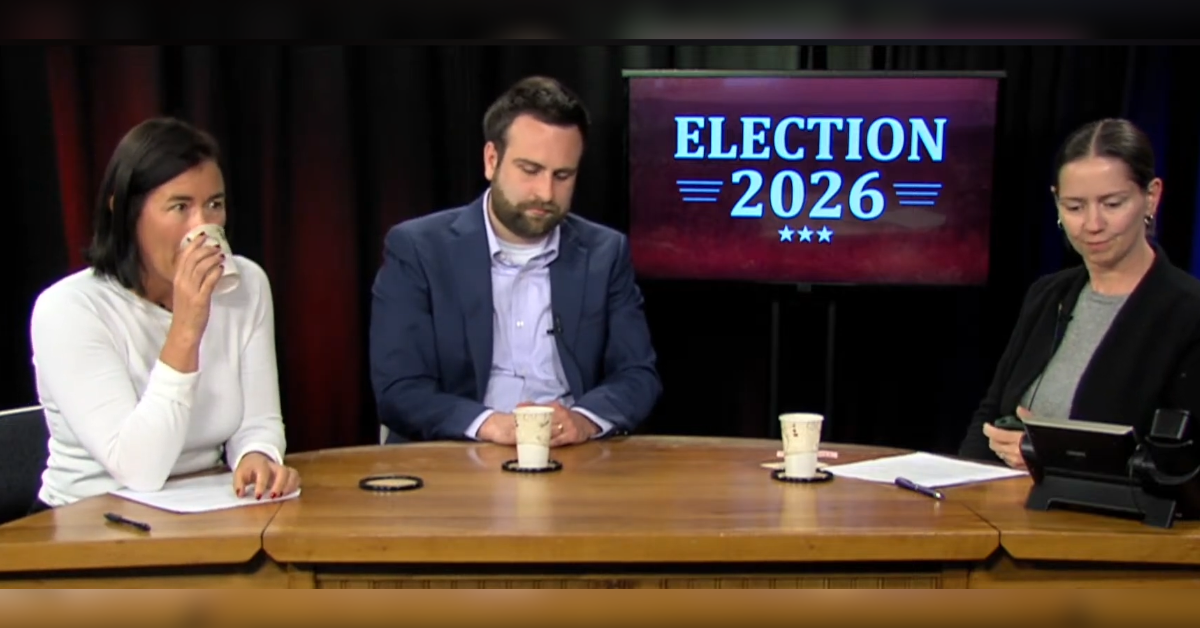
In a debate held last night hosted by Town Meeting TV for the Chittenden County’s state’s attorney race, incumbent Sarah George and Republican challenger Jace Laquerre presented starkly different visions for the office Tuesday evening, clashing over public safety, drug policy and the very nature of the contest itself.
George, the Democratic nominee now seeking a third full term, opened by emphasizing her 16 years as a prosecutor and her record since taking office in 2017. “I went to law school to do this work and I’ve been doing this work ever since,” she said.
“I started as a deputy state’s attorney and eventually became the elected state’s attorney in 2017. During that time, we have been working every day in our office to implement evidence-based research, evidence-based policies that address and highlight the inherent and intentional disparities in our legal system.”
She pointed to efforts targeting disparities in arrests, prosecutions and incarceration, the elimination of the COVID-era case backlog, improved handling of domestic violence cases, and connecting repeat offenders to services. “I would be honored to continue doing that work for the next four years,” George said.
Laquerre, a Milton software engineer who is not a lawyer, framed his candidacy differently from the start. “To be clear, I am not an attorney,” he said. “But I’m also not running for this position for myself. I’m running as a stand-in candidate to give voters a choice in what would have otherwise been an uncontested election.”
He argued that public safety and crime in Burlington and the rest of Chittenden County had trended in the wrong direction over the past nine years under George. “I believe her policies have contributed to that decline,” Laquerre said. “And what I think Chittenden County needs in the state’s attorney’s office right now is a prosecutor and not an activist. So I’m running to give voters that choice.”
George, just weeks ago, narrowly survived a Democratic primary challenge in August from former colleague Bram Kranichfeld, winning by roughly 1,000 votes amid sharp criticism of her progressive approach to prosecution.
Critics, including some law enforcement voices and residents concerned about visible disorder in Burlington, have faulted policies limiting cash bail requests and prosecutions tied to low-level traffic stops. Supporters credit George with reducing unnecessary incarceration and focusing resources on more serious cases while addressing racial and economic disparities in the justice system.
With no Republican primary contender, the general election had been expected to be a formality until the Vermont GOP named Laquerre as a “placeholder” candidate in late August. The party’s strategy is explicit: if Laquerre wins, he would resign, creating a vacancy that Republican Gov. Phil Scott — who originally appointed George in 2017 after T.J. Donovan left to become attorney general — could fill by appointment for the remainder of the four-year term.
That arrangement dominated a later portion of the debate.
Asked about the Vermont GOP’s expectation that Scott would appoint a replacement if their candidate is elected and resigns, Laquerre defended the approach as imperfect but necessary. “I’ll be the first person to say that what we’re doing is a little bit unorthodox,” he said.
“I’ll be the first person to say that it should not be the standard way of doing things. But I think in this case where there was a candidate that won less than 50% of the primary vote for her party going up unchallenged in a general election didn’t sit well with a lot of people,” Laquerre continued.
He rejected George’s characterization of the strategy as undemocratic. “I don’t agree with my opponent’s statements that it’s undemocratic. I think giving people a choice is always good for democracy and I think it’s un-American to walk into the ballot booth and only have one name on the ballot.”
George pushed back firmly. “Anybody who wants to run for this office because they think that they can do a better job or have better ideas, I welcome that. I always have. I think that that is the beauty of our democracy,” she said. “But my opponent continues to say that this is giving voters a choice and that is not what it’s doing. It’s giving people another name that is not actually going to be the person who does this job.”
She argued that voters would effectively be choosing no one, leaving the decision to the governor. “My concern about it is that they’re actually voting for nobody to be the state’s attorney and then leaving it up to whoever is elected to decide who is the state’s attorney in this county despite what the voters of Chittenden County have decided. That is why I think it’s undemocratic.”
George asserted that Laquerre is “incredibly disingenuous” to say that it is a choice because it’s not. And she also took issue with the fact that, if voters choose Laquerre, nobody knows who the next state’s attorney could be.
The debate also turned to one of the most visible and contentious issues in Burlington: overdose deaths and public drug use. Asked about a proposed overdose prevention center, sometimes called a supervised injection site, George offered a personal and policy-based defense.
“Since becoming a prosecutor, one of the things I did not expect to have to do was to go to the scenes of untimely deaths,” she said. “Our office gets called for every single person who dies in our county, including people who die from overdose fatalities. And one of the first ones I went to was a 24-year-old girl with a knee injury that had gotten addicted to opioids. And I had to sit in a room with her family as they grieved a loss that most of us can ever imagine. I went on to do that what seems like hundreds of times since. And it never gets easier.”
Those experiences, she said, had convinced her that an overdose prevention site is the right response. “I was one of the first elected officials back in 2017 to ask the state to consider this and I’ve been advocating for it ever since.”
Laquerre agreed that drug use and overdoses rank among Burlington’s biggest problems and supported connecting people to services after early arrests for possession or use. “I don’t think incarceration helps those first-time offenders,” he said. But he drew a sharp line against supervised consumption sites. “I don’t agree with the so-called safe injection sites. I don’t think that would be right for Burlington.”
For repeat offenders, he said, the calculus changes. “Maybe where we would disagree is the seventh or eighth time people are being arrested for drug use and drug possession. I think at that point the thing that’s safe for that individual as well as the community is to incarcerate those people.”
The race has become a proxy fight over progressive prosecution in Vermont’s most populous county. George’s tenure has been marked by efforts to reduce reliance on cash bail, limit certain low-level prosecutions and emphasize treatment and services over incarceration for nonviolent offenses.
Supporters see these as evidence-based reforms that address systemic inequities. Critics, amplified during the primary and now by the Republican challenge, contend the approach has contributed to disorder, particularly in Burlington, where public drug use, retail theft and perceptions of declining safety have fueled frustration among some residents and business owners.
It is not yet clear if the candidates will engage in any more debates, though if they do BDN will of course be there to cover it.
You can watch the full debate by Town Meeting TV here.
Leave a Reply