
By Kolby LaMarche
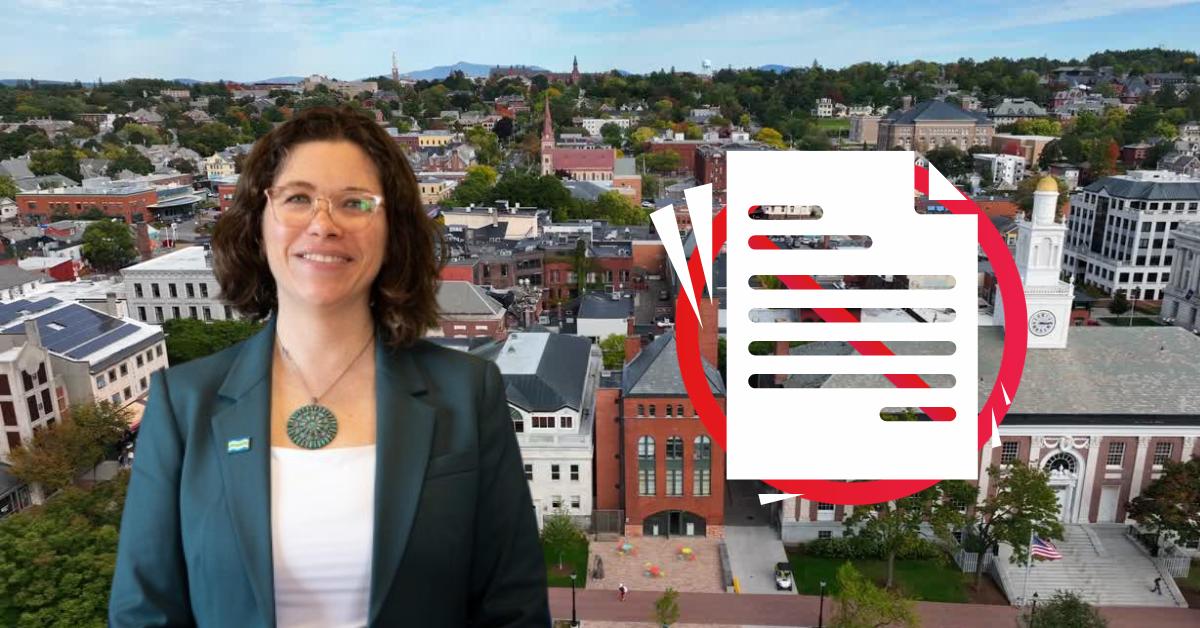
Mayor Emma Mulvaney-Stanak has released a statement urging Democrats to halt their Burlington Forward proposal due Monday night and calling out the caucus for not meeting with her after their press conference earlier this week.
In her statement, released tonight, the mayor says she has reached out to Democrats “multiple times” and, yet, has been met with “a refusal to meet and followed by silence.”
The mayor then asked several things of Democratic councilors, which would all but culminate in the gutting of key points within the Democrat’s resolution.
Among many things, Mulvaney-Stanak requested the Democrats claw back their planned enforcement on encampments across the city, withdraw mandates that she says city departments simply cannot meet, and identify more ways the state can help.
The mayor prefaced that list with a general request for the entire process, the introduction of the slate of policies, to be stopped “until we can meet to talk through a number of concerns,” she wrote.
Democrats have not yet publicly responded to the mayor’s remarks, requests, or the mayor herself, allegedly. But what still may be top-of-mind for Democrats was the mayor’s initial response to the proposal, labeling the approach as the “hallmark of more conservative politics – and whose effectiveness has been debunked around the country.”
In the past few days, Burlington Daily News, as well as residents, have received a flurry of communications from the mayor’s office, more frequent now than at any point thus far in the mayor’s administration.
In her most recent correspondence, Mayor Emma Mulvaney-Stanak again defended Burlington’s progress, arguing her administration is delivering measurable improvements despite criticism
Through a pair of lengthy public emails sent to residents this week, Mulvaney-Stanak outlined what she described as an evidence-based community safety strategy, highlighting declines in several crime categories, expanded police patrols, homelessness initiatives and new accountability programs.
The messages largely avoid directly addressing the Burlington Forward resolution, which the mayor labeled as “conservative” earlier this week, where Democrats say the city is on the wrong direction on issues including public safety and governance.
The emails also come as Gov. Phil Scott announced that the Vermont State Police will increase their presence in downtown Burlington through mid-August, a move welcomed by some local officials and business owners who have called for additional enforcement.
Mulvaney-Stanak further acknowledged, however, that it was “unfortunate” that the governor’s announcement didn’t reach her office first, rather, it was released to the media. Democrats in the city have, in the past, had similar grievances with the mayor.
Democratic officials in recent months have frequently criticized the mayor’s office over claims they did not adequately inform the council about major policy decisions or initiatives before they became public. Mulvaney-Stanak, in those instances, also allegedly informed the media first, as the governor did.
The mayor said she hopes to revive discussions surrounding the 14-point public safety plan she previously developed with the governor while adding a new proposal focused on creating a statewide response to homelessness.
From there, the mayor shifted to a broader defense of her administration’s philosophy toward public safety.
“Our work is grounded in the belief that both compassion and safety are essential,” Mulvaney-Stanak wrote, arguing Burlington has sought to balance enforcement with services rather than treating the two approaches as mutually exclusive.
She described the city’s strategy as one centered on what she called “fair accountability,” emphasizing not only holding individuals responsible for criminal behavior but also addressing underlying issues such as housing instability, mental illness and substance use.
The mayor acknowledged that residents continue to see visible signs of those challenges, particularly during the summer months when parks and public spaces are heavily used.
She argued, however, that those conditions should not be viewed as evidence that the city’s overall approach has failed.
Instead, Mulvaney-Stanak characterized Burlington’s public safety challenges as, again, part of a larger statewide crisis driven by years of underinvestment in housing, behavioral health services, addiction treatment and mental health care.
She also questioned whether increased enforcement alone could solve those issues, pointing to overcrowded prisons, court backlogs and staffing shortages affecting police departments throughout Vermont.
“The prison populations are already at their highest levels since 2019,” she wrote, arguing that incarceration by itself has not addressed the root causes contributing to crime and public disorder.
In her later email, the mayor cited year-end 2025 statistics showing violent crime had declined to levels not seen since 2021. She also pointed to decreases in homicides, burglaries, retail theft, vehicle thefts and vehicle break-ins while noting that drug arrests increased, which she attributed to more proactive policing.
According to Mulvaney-Stanak, those trends reflect a coordinated effort involving increased police visibility, expanded partnerships with community organizations and more strategic use of limited public safety resources.
She acknowledged that significant challenges remain but argued the city’s overall direction is producing measurable results.
Critics, however, have argued that crime statistics do not necessarily reflect residents’ daily experiences.
Downtown business owners and neighborhood advocates have continued to raise concerns about visible drug activity, encampments, public disturbances and quality-of-life issues, saying many people still perceive downtown as less safe than in previous years despite reported declines in some criminal offenses.
Much of the mayor’s message focused on programs implemented during the past two years.
She highlighted the city’s Safe Outdoor Sites working group, a cross-departmental team that meets weekly to coordinate responses to encampments, oversee cleanups when necessary, respond to complaints, connect unsheltered residents with services and refine homelessness policies.
Mulvaney-Stanak also emphasized expanded investments in the Howard Center’s Street Outreach Team and changes to the roles of Community Service Officers and Community Service Liaisons, who now primarily respond to mental health crises and overdose-related calls. She said the shift allows sworn police officers to devote more time to criminal investigations and targeted enforcement.
The mayor also noted that Burlington Police increased downtown foot patrols during 2025, particularly around Church Street Marketplace and City Hall Park, describing the increased visibility as both a crime prevention strategy and an effort to rebuild public confidence in the department.
The administration is also reviving its “Hot Spots” strategy, which coordinates multiple city departments and community partners to respond to areas experiencing persistent public safety concerns.
Mulvaney-Stanak said lessons learned from efforts around the Fletcher Free Library and a nearby parking garage last year are now being applied to City Hall Park and the Battery Park bandshell.
The city is also evaluating additional maintenance and infrastructure improvements, including expanded power washing, additional waste disposal facilities and the possibility of rotating outdoor shelter locations in partnership with local organizations.
Housing and homelessness also occupied a significant portion of the mayor’s emails.
Mulvaney-Stanak argued Burlington cannot address homelessness on its own and renewed calls for greater state investment in low-barrier shelters, year-round shelter capacity and housing resources.
She highlighted the city’s support for efforts to establish a new 100-bed regional low-barrier shelter, funding provided for the Bridges Recovery Shelter and the expanded COTS Waystation shelter on Pearl Street.
The mayor also pointed to the city’s support for the Champlain Valley Office of Economic Opportunity’s Community Resource Center and advocacy that helped secure additional municipal homelessness funding through legislation approved this year.
Again, the mayor framed many of those efforts as examples of areas where municipal government can only go so far without stronger state support.
That argument differs from critics who contend City Hall has too often emphasized shortcomings at the state and federal levels rather than focusing on policy decisions within the city’s own control.
The emails also devoted considerable attention to initiatives the administration describes as strengthening accountability while reducing repeat offenses.
Among them is the Situation Table, a weekly partnership involving more than 30 public safety, health and human service organizations that coordinates interventions for individuals considered at elevated risk before crises escalate.
Mulvaney-Stanak said the program has handled 95 situations during its first year, with roughly 60% later closed after participants’ risk levels declined.
She also highlighted the City Circle restorative justice pilot, which diverts certain lower-level ordinance violations into a facilitated accountability process rather than immediately sending cases through the traditional court system.
Participants who complete agreed-upon outcomes have citations dismissed, while those who decline participation proceed through the normal legal process.
The mayor additionally pointed to the Accountability Docket, a temporary initiative developed with state partners that sought to resolve repeat misdemeanor cases more quickly while connecting defendants with behavioral health and substance use services.
According to Mulvaney-Stanak, approximately 78% of the docket’s cases were cleared during the pilot, reducing court backlogs in Chittenden County.
Programs such as Situation Table and City Circle have received support from advocates of restorative justice and public health approaches, while critics have questioned whether they place too much emphasis on diversion rather than prosecution, particularly as residents continue expressing concerns about repeat offenders and visible public disorder.


Leave a Reply