
By Kolby LaMarche
Burlington city planners have put forward a draft neighborhood plan for the New North End that calls for targeted housing growth, changes to North Avenue and new public spaces across one of the city’s largest residential areas.
The plan is now under review by the Burlington Planning Commission, after having had multiple sessions of public input.
The plan is part of the city’s broader planning project “PlanBTV”. It aims to guide development, transportation investments and land use decisions in the New North End and beyond. City officials say the neighborhood is well positioned to contribute to the roughly 7,000 new housing units Burlington needs by 2050.
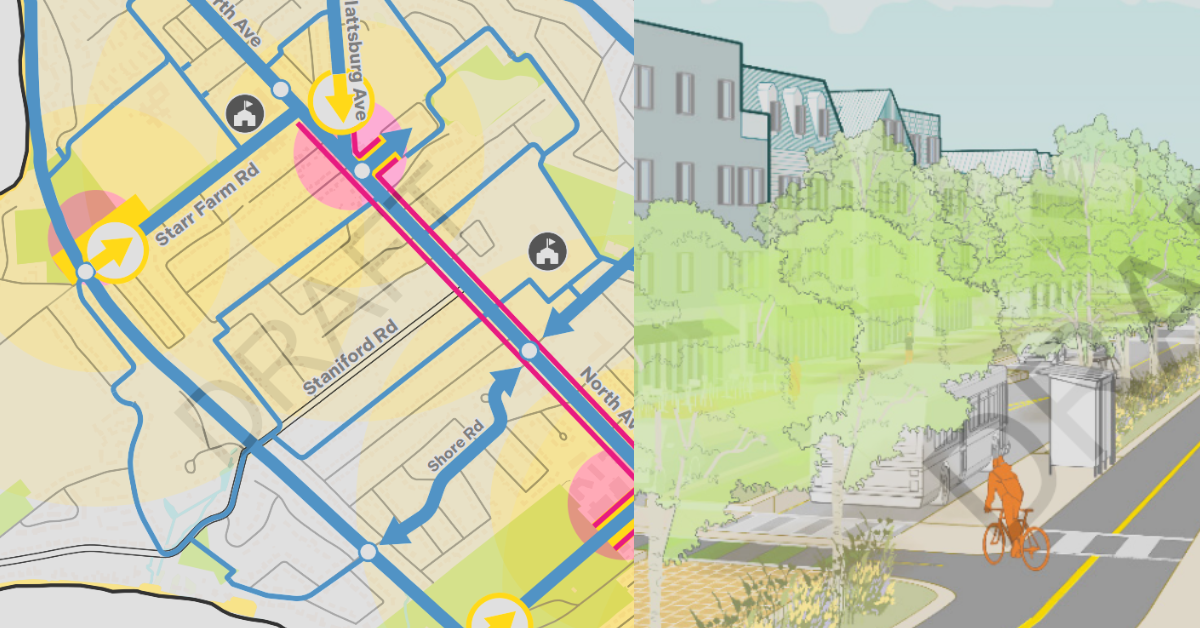
On transportation, North Avenue received significant attention as the corridor of much of the city’s traffic, foot, bike, and car. The plan recommends a separated two-way bikeway as the preferred design. It would include on-street parking and loading, trees and green stormwater infrastructure, and improved transit stops. Implementation would take place in phases, beginning with the section from Killarney Drive to Institute Road.
Specific intersections received study. A modern roundabout is the preferred option at North Avenue and the VT 127 ramps. Further study is suggested at North Avenue and Ethan Allen Parkway. At Plattsburg Avenue, a “bend North Avenue” alternative scored well for safety and feasibility.
The plan establishes a three-tier network for walking and biking: separated bike lanes on high-volume corridors, shared-use paths in lower-density areas, and neighborhood greenways on quiet residential streets.
The plan also recommends restoring Sunday service on Green Mountain Transit’s Route 7, increasing frequency as the neighborhood grows, and installing shelters at high-ridership stops. New mobility hubs would connect walking, biking and bus service.
Transportation demand management proposals include expanding CarShare Vermont into the neighborhood, launching outreach and education programs, supporting Safe Routes to School at the neighborhood’s schools, and establishing a neighborhood mobility advisory committee with annual mode-share tracking.
The Burlington Greenway would see improvements too, addressing winter maintenance, crowding, lighting, bike parking and connections east of North Avenue through sixteen recommendations on connectivity, capacity, year-round use and placemaking.
On urban design, the plan identifies focus areas for higher-intensity mixed-use development along North Avenue. These would include housing, commercial space and public plazas connected to the mobility network. Five focus areas were selected through community engagement and a “soft sites” analysis.
The placemaking framework addresses the need for smaller public squares, activated streetscapes and community gathering spaces. Recommendations include design guidelines for North Avenue buildings, creation of a neighborhood placemaking committee, more community gardens, plaza activation at key sites and public art at gateways.
The plan charts a course where new housing, better streets and more walkable neighborhood centers work together to enable residents to meet daily needs without a car. Much of the plans main points align with housing priorities set out by the mayor earlier this year.
The New North End is a community of approximately 10,500 residents bounded by Lake Champlain to the west and the Winooski River to the north and east. North Avenue serves as the main north-south spine.
Public engagement for the plan included a project advisory committee that met four times, along with open houses, workshops, pop-up events, focus groups and online surveys. Feedback pointed to desires for safer streets, more housing options that fit neighborhood character, better access to daily services and protection of the area’s natural spaces.
The draft organizes its approach around three interconnected frameworks: transportation, urban design and placemaking.
The neighborhood vision statement developed with residents states that New North End residents envision their neighborhood growing to become a well-connected, inclusive and vibrant community that balances growth with affordability, sustainability and a strong sense of place.
The city set out six principles to frame the plan: foster a strong and inclusive sense of community, expand housing choice and affordability, create a safer, more connected transportation network, strengthen neighborhood centers and walkable mixed-use areas, protect and enhance natural spaces, and prioritize sustainability and green infrastructure.
City officials say the plan does not automatically change zoning but will inform future code updates, capital budgeting and development reviews. Adoption would provide policy guidance for future decisions.
Supporters see opportunities for more walkable areas and safer streets. Others worry about changes to the area’s character, particularly the creation of more bike lanes on the already busy North Ave.
The draft is over 200 pages long and includes detailed contents covering the current conditions in the New North End, the neighborhood vision, each framework and an implementation chapter with specific actions. You can read, and view the images, here.
BDN has done its best to summarize the vast initial phases of the plan. As public comment and board action comes, we will report it.


Leave a Reply