
By Kolby LaMarche
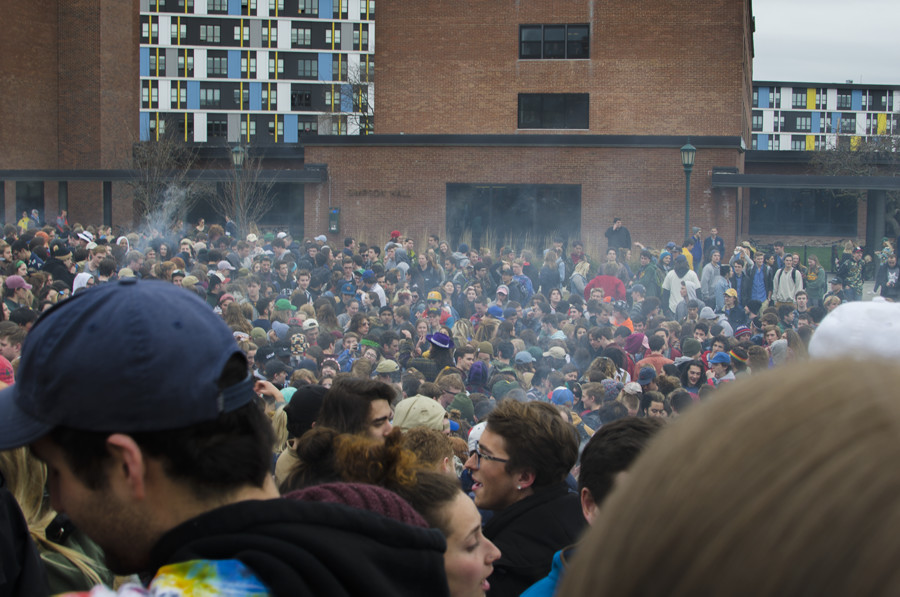
At 4:20 p.m. each April 20, clusters of students at the University of Vermont gather on Redstone Green and other campus lawns, marking an unofficial tradition that has persisted through shifting drug laws and repeated university warnings for decades.
The annual “4/20” observance, tied to the decades-old cannabis counterculture reference, is not organized or sanctioned by the university. Still, it draws consistent, large student participation, particularly in favorable weather, and remains one of the most visible student-led gatherings of the spring semester.
The term “420” originated in California in the 1970s as slang for marijuana use and later became associated with April 20 as an informal holiday. At UVM, the date evolved into a recurring campus event by the early 2000s, when groups of students began congregating outdoors at the same time each year.
The gathering expanded gradually, aided by social media and word-of-mouth, and became a fixture of campus life – to the worry of some parents over the years.
Vermont decriminalized possession of small amounts of cannabis in 2013, replacing criminal penalties with civil fines. In 2018, the state legalized possession of up to one ounce of marijuana for adults 21 and older.
Retail sales began in 2022 under a regulated market. Those changes removed much of the legal risk that once surrounded public consumption, though restrictions still remain, as does the unregulated sale of marijuana.
Cannabis use is still prohibited in public spaces under state law, and it remains banned on university property. UVM, like other federally funded institutions, maintains policies that prohibit possession and use of marijuana on campus, regardless of state legalization. Violations can result in student conduct action but seemingly, for this event, never have.
University officials reiterate that policy each year in advance of April 20, often through campus-wide communications. Enforcement, however, has been historically varied, with a visible but limited presence from campus safety personnel and security during peak gathering and smoking times.
The legal shift has coincided with changes in cannabis itself. Modern marijuana products are significantly more potent than those commonly available when the 4/20 tradition began.
THC concentrations in cannabis flowers now routinely exceed 20%, with some strains testing higher. Concentrated products, including oils and waxes, can reach substantially greater levels. Students of the early 2000s would have likely been using cannabis flowers somewhere near 6%.
Public health officials have linked higher potency to increased risks, including acute intoxication, anxiety, and impaired judgment. Those concerns have informed the university’s messaging and presence in recent years, which has emphasized harm reduction alongside policy reminders.
At the same time, UVM has made a sustained effort to reshape the tone of April 20 through alternative programming.
University departments and student groups have promoted wellness-focused events on or around the date, including organized runs, walks, and recreational activities.
Among the more visible efforts is an annual 4.20-themed 5K, scheduled to coincide with the traditional gathering time. Other programming has included fitness classes, outdoor games, and resource fairs focused on health and substance use education.
Administrators frame those efforts as a way to offer students structured alternatives and reduce potential harm, rather than attempting to eliminate the gathering altogether.
For some students, the event carries little political or cultural significance beyond its social dimension. It functions as a shared moment near the end of the academic year, comparable to other informal campus traditions that draw large crowds without official coordination.
Where once the focus was on decriminalization, students now say it’s a chance to get a break before finals.
For others, it reflects broader shifts in attitudes toward cannabis, particularly among younger adults who came of age during legalization, like Gen Z. The normalization of marijuana use in Vermont and other states has reduced the stigma that once surrounded the activity, even as institutional rules remain in place.
Each year, the same sequence unfolds. Students gather. The university reiterates its rules. Alternative events proceed in parallel.
And at 4:20 p.m., the crowd marks the moment, whether or not it is officially acknowledged.
Leave a Reply