
By Kolby LaMarche
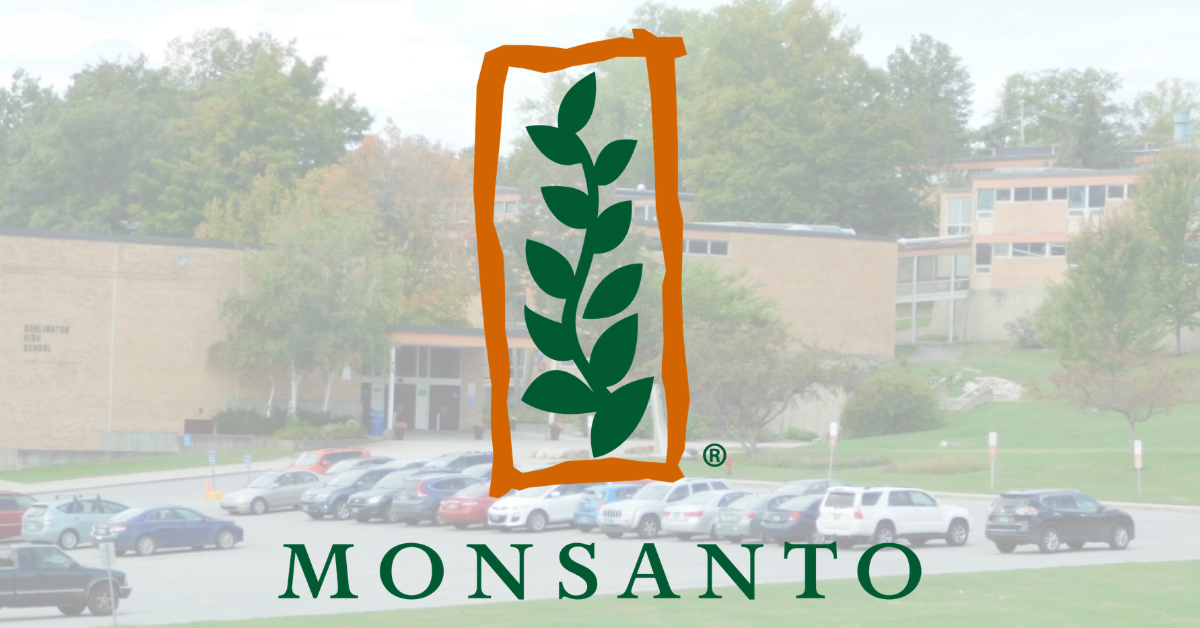
A federal judge has cleared the Burlington School District’s multimillion-dollar lawsuit against Monsanto Co. and its corporate successors to proceed to trial, advancing claims that decades-old PCB contamination forced the closure and demolition of Burlington High School and the Burlington Technical Center.
U.S. District Judge William Sessions III denied the defendants’ motion for summary judgment in a ruling filed April 16, 2026.
The decision means a jury will decide key factual disputes over what Monsanto knew about the risks of polychlorinated biphenyls, what warnings it provided, and whether the contamination and the district’s response were foreseeable.
The Burlington School District sued Monsanto, Solutia Inc. and Pharmacia LLC in federal court in December 2022. The companies are the successors to the original Monsanto, which manufactured nearly all PCBs sold in the United States from the 1930s until it stopped production in 1977.
The district alleges the chemicals, used in building materials at the high school campus on Institute Road, rendered the facilities unsafe and drove up costs that now exceed $190 million for a full replacement.
PCBs are man-made compounds once widely used as plasticizers in caulk, sealants, paints, adhesives and other construction products built between the 1950s and 1970s.
They do not break down easily and can volatilize into indoor air over time, contaminating dust and surfaces. Exposure has been linked to health risks, including liver damage and developmental effects, with children and adolescents particularly vulnerable.
The trouble at Burlington High School surfaced in July 2019 during environmental testing tied to planned renovations. Follow-up air sampling from April to June 2020 in multiple buildings detected PCB concentrations as high as 6,300 nanograms per cubic meter — far above Vermont’s school action level of 100 ng/m³ for high schools and the general screening level of 15 ng/m³.
Sources included caulking, glazing compounds, flooring adhesives and spray-on insulation.
District officials shut down the campus in September 2020 to protect students and staff. The school and technical center buildings, constructed mostly in the mid-1960s, were later razed. Demolition wrapped up in 2023.
Students and faculty have since been housed in a leased former Macy’s department store in downtown Burlington, which required costly modifications and ongoing rent payments, aside from having little to no windows for students.
The district’s complaint states that, without the PCB contamination, the existing buildings could have been renovated rather than replaced.
It seeks to recover investigation costs, temporary facility expenses, demolition and the full price tag of designing and building new safe facilities.
Court filings indicate the district is pursuing approximately $135 million in compensatory damages, with the overall project estimated at more than $190 million. The new Burlington High School is scheduled to open for the fall 2026 semester.
In the lawsuit, the district argues Monsanto knew for decades that PCBs posed health hazards but continued to market them for “open use” applications such as construction materials.
Internal company documents cited in court filings date back to the 1930s and 1950s, showing awareness of toxicity studies, worker illnesses and vapor risks. The complaint alleges Monsanto promoted Aroclor-brand PCBs as suitable plasticizers for caulk and sealants while downplaying dangers to the public and failing to provide adequate warnings for end-use products in schools and other buildings.
“Monsanto manufactured and promoted its commercial PCB products for use in construction,” the complaint states. “Indeed, Monsanto developed a range of PCB-based plasticizer products specifically intended for use by the construction industry, promoting both their ‘non-toxic’ and ‘non-volatile’ profile.”
The district contends the chemicals’ persistence and tendency to off-gas made contamination in a school setting “inevitable” and “unreasonably dangerous,” especially for children.
It further accuses Monsanto of misleading the public about the risks, leading directly to the contamination that forced the campus closure and replacement.
Burlington Superintendent Tom Flanagan welcomed the judge’s ruling. “BSD is confident that we have a strong case against Monsanto, and we are grateful that the judge will allow this lawsuit to go to trial,” he said in a statement to WCAX. “We look forward to continuing to pursue justice for our community.”
Flanagan had earlier described the filing as “one step closer to holding the producer of these toxic chemicals accountable for the harm it has inflicted on our community.”
Monsanto and its successors have denied liability. In a statement provided after the ruling, a company spokesperson said the products at issue were manufactured by third parties that purchased bulk PCBs from Monsanto and incorporated them into their own materials.
The company also pointed to maintenance decisions by the district and noted that Vermont law may limit recoverable damages to remediation costs rather than full demolition and new construction.
“Monsanto has not produced PCBs for nearly five decades, conducted hundreds of studies on the safety of PCBs, and provided warnings to its customers based on the state-of-the science at the time,” the statement read.
The defendants had argued they could not be held responsible for how others used the chemicals or for harms they claim were not foreseeable. Judge Sessions ruled that disputed facts — including Monsanto’s knowledge of risks, the adequacy of warnings and the reasonableness of the district’s actions — must go to a jury.
The ruling also left open the possibility of punitive damages if the jury finds evidence of particularly egregious conduct.
No trial date has been set. The case remains in U.S. District Court in Vermont.
The Burlington lawsuit is part of broader litigation over PCBs in Vermont schools and elsewhere.
Nearly 100 other school districts, the state attorney general and former teachers have filed separate actions against Monsanto alleging similar contamination issues. Those cases are proceeding on parallel tracks.
Officials say the lawsuit aims to shift the cost of providing a safe learning environment back to the company that produced the chemicals decades ago. Without a favorable verdict or settlement, local taxpayers and state aid would shoulder the burden of the new campus.
District leaders maintain the suit is not just about dollars but about ensuring schools remain free of hidden hazards.

Leave a Reply