
By Kolby LaMarche
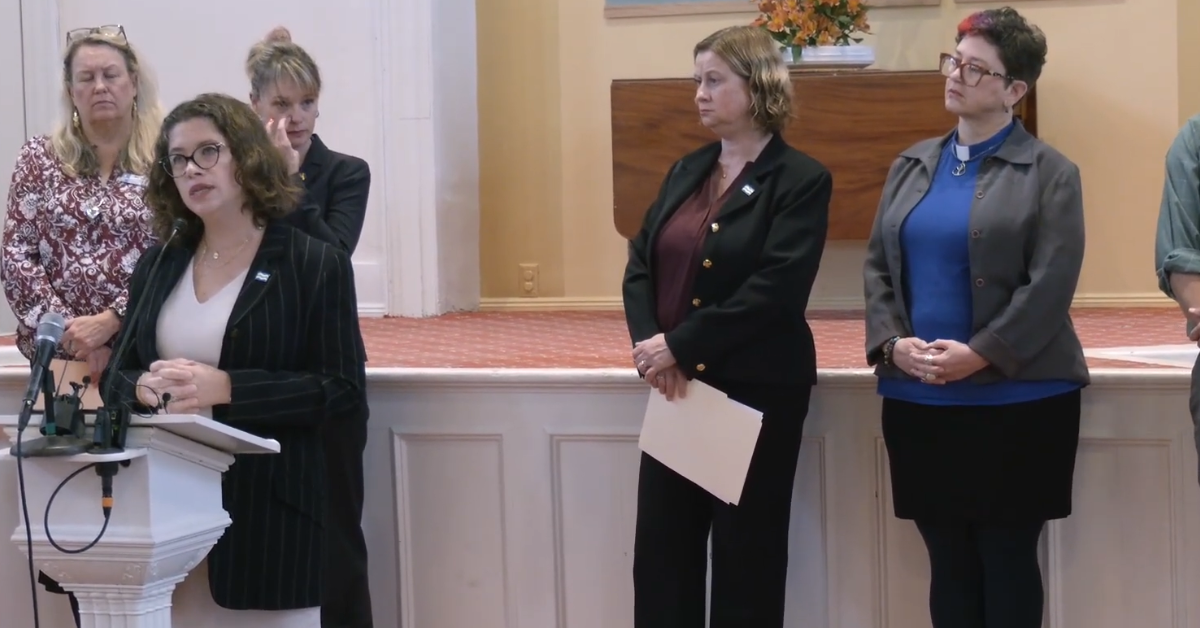
In a press conference held yesterday at the Sanctuary of the First Unitarian Universalist Society of Burlington, Mayor Emma Mulvaney-Stanak signed an order relating to immigration, formalizing the city’s approach to implementing Vermont’s Act 150.
The state law, which took effect in June, prohibits civil arrests, including those by federal immigration authorities, at a wide range of sensitive locations such as schools, courts, hospitals, places of worship, public libraries, polling places, shelters, social service facilities, and city- and state-owned government buildings.
The mayor was joined by community partners and advocates, including state Sen. Tanya Vyhovsky, the lead sponsor of the legislation that became Act 150; Jordan Souder, a policy advocate with the ACLU of Vermont; Mary Danko, director of the Fletcher Free Library; Katherine Schad, the city’s chief administrative officer; and Rev. Karen Johnston, senior minister at the host congregation.
“Sensitive locations form the backbone of our communities,” Mulvaney-Stanak said. “They are essential to thriving, healthy, and stable societies, but people need to trust that they are safe and accessible by everyone, including and especially our most vulnerable neighbors.”
Executive Order 2026-2 directs the city to reinforce protections at these sites in response to the state law, update its policies, signage, and employee training, and partner with legal service providers to train and support operators of sensitive locations in Burlington.
It also clarifies that the Burlington Police Department will not respond to U.S. Immigration and Customs Enforcement activity at those locations unless there is a reported public safety concern. If officers do respond, their role is limited to maintaining public safety under existing department policy.
Signed into law by Gov. Phil Scott, Act 150 expands an existing privilege against civil arrest by barring such arrests while a person is traveling to, entering, remaining at, or returning from a court proceeding or educational institution, or while on the premises of specified protected sites.
Civil arrest is defined as one made to compel attendance at a civil or immigration proceeding, distinct from arrests under criminal warrants or court orders. The law includes limited exceptions, such as arrests pursuant to a judicially issued warrant, for contempt of court, or to maintain order and safety in a courtroom.
Supporters, including the ACLU of Vermont, have argued that the measure helps ensure immigrant residents can access essential services without fear. Critics, and federal officials, have noted that federal authority generally preempts state restrictions on immigration enforcement, though the law may limit local cooperation and encourage operators of sensitive sites to withhold assistance.
The signing comes amid heightened attention to federal immigration enforcement in Vermont, with thus far limited public operations by federal officers in Burlington. Data released by ICE showed 124 arrests in the state through July 2026, more than triple the total for all of 2025.
However, an analysis by Vermont Public found that the figures were inflated by the inclusion of many individuals first apprehended by U.S. Customs and Border Protection near the Canadian border and later transferred to ICE custody.
Interior “at-large” arrests by ICE in Vermont numbered 29 in the first seven months of 2026, compared with 35 for all of 2025. The agency maintains, as it has, a relatively small presence of removal officers in the state.
The most significant local incident occurred in March on Dorset Street in neighboring South Burlington. ICE agents conducting surveillance attempted to arrest a Mexican national previously deported who was facing an illegal re-entry charge and a pending DUI case.
The man fled in a vehicle, leading to a multi-vehicle crash near South Burlington High School and University Mall during morning rush hour. He then ran into a nearby home. Agents surrounded the residence; a crowd of protesters eventually numbering in the hundreds formed a human chain and blocked access for much of the day.
Clashes erupted as agents and supporting local and state officers cleared the area; protesters were pushed, and some reported the use of chemical irritants and flash-bang devices by federal personnel. Several protesters were briefly detained by Burlington and state police but most charges were later declined by Chittenden County State’s Attorney Sarah George, who referred some cases to restorative justice.
Not long after, Mayor Mulvaney-Stanak issued a strong statement the day after calling the federal actions “deeply disturbing” and “instruments of terror inflicted on our communities.”
She confirmed that Burlington police had complied with her earlier Executive Order 2026-1, signed in February, which established protocols for responding to potential escalations in federal immigration activity.
That earlier order reaffirmed that the police department would not engage in or assist with civil immigration enforcement, directed updates to emergency plans and alert systems, and required officers responding to such scenes to document events, preserve evidence, and ensure medical care without interfering with federal operations.
Over the subsequent months, the city has continued to sound the alarm, like the ever-present alert banner on their website, despite limited federal action in the city.
Elsewhere in the county, protests have targeted ICE facilities in nearby Williston, including the National Criminal Analysis and Targeting Center, leading to multiple arrests of demonstrators. In recent weeks, state and federal prosecutors filed trespassing and related charges against some of those protesters after the local state’s attorney declined earlier cases.
Activists also raised concerns about ICE’s occasional use of Burlington International Airport for detainee transport.
At Wednesday’s event, speakers emphasized that Act 150 represents progress but not a complete solution. Mulvaney-Stanak noted that municipalities need clearer state guidance on Vermont’s model Fair and Impartial Policing Policy amid intensified federal enforcement.
Over the summer she convened a working group of city councilors and staff and consulted advocacy organizations. Recommendations are expected to form part of the city’s legislative priorities for the coming session.
The Department of Homeland Security pushed back on the new executive order. A spokesperson called it “nothing more than a political stunt by Vermont sanctuary politicians” and told WPTZ that ICE does not target hospitals, schools, or churches, though arrests can occur at those locations when necessary for public safety threats.
The agency described its operations as intelligence-driven.
Rev. Johnston, who was present at the March 11 Dorset Street scene, told the gathering she had seen the human impact of enforcement firsthand.
Library director Danko spoke of the need for public institutions to remain places where people can access information and services without fear. Other city officials stressed that the order is intended to provide clarity for employees and partners while aligning local practice with state law.
Leave a Reply