
By Kolby LaMarche
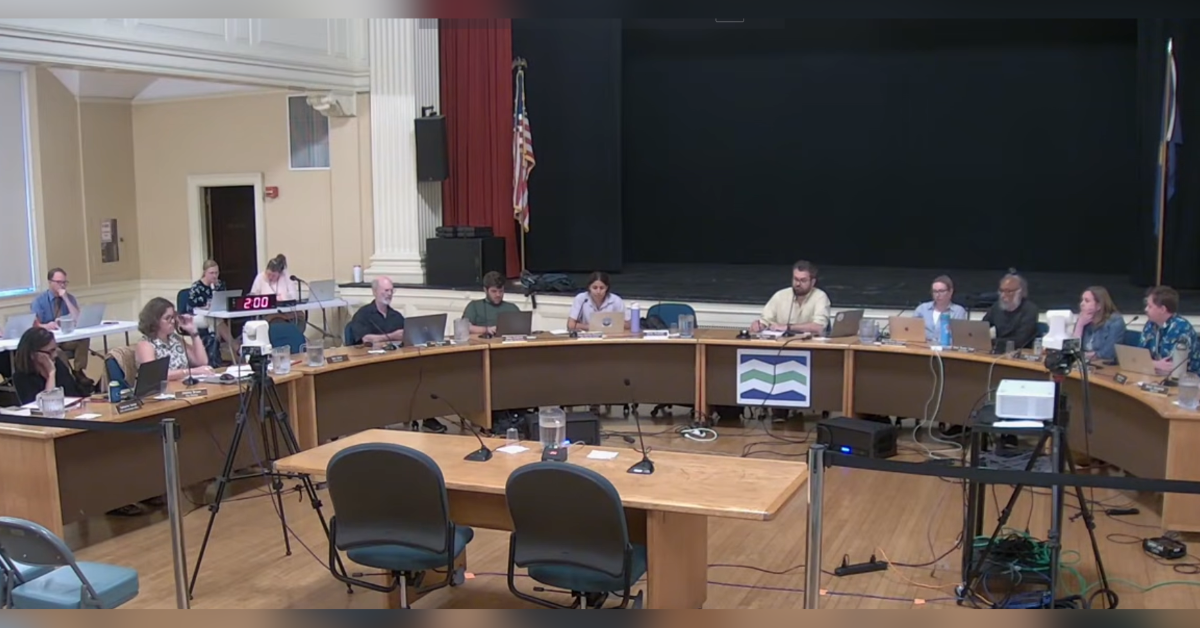
The Burlington City Council’s annual process of filling seats on boards and commissions turned contentious Monday night, as debates over political balance, past statements, and representation of immigrant communities dominated discussions and led to split votes on numerous key appointments.
Councilors reviewed and voted on nominees for various city boards following public comment, with the Board for Registration of Voters and the Police Commission emerging as particular flashpoints on the Democrat-majority council last night.
The first major point of contention arose during public comment. Annie Schnider, a seven-year member of the Board for Registration of Voters, addressed the council regarding the nomination of Jeff Comstock, a long-engaged New North End resident.
Schnider acknowledged early in her comments the awkwardness of a sitting board member weighing in on a potential colleague’s candidacy.
“I realize it is unusual for a sitting member of a board to comment on the candidacy of a potential member and this could be extremely awkward,” Schnider said. Continuing, she stated that it was “already on the record…that Jeff Comstock has transphobic and anti-immigrant views.” Schnider recounted an incident at a Ward 4 and 7 Neighborhood Planning Assembly (NPA) meeting and, more recently, at a voter board meeting.
Schnider, and some other councilors later on in the meeting, pointed at Comstock’s refusal to use preferred pronouns of community members. Some time after the incident, and media coverage, multiple members of that assembly resigned, citing Comstock in their reasoning, making many feel “unwelcome”.
Soon thereafter, the city council passed a NPA-backed resolution aimed at keeping behavior like Comstock’s out of assemblies across the city.
Schnider emphasized the importance of voters feeling “treated with friendliness, kindness, and respect, especially with their identity,” and urged the council not to appoint Comstock.
Council President Ben Traverse, a Democrat representing Ward 5, described Schnider’s remarks as falling into “a bit of a gray area of sorts.” Schnider concluded her comments by again pressing the council to reject the nomination.
Comstock did not attend the meeting for his appointment.
The Comstock nomination stems from a broader dispute over the composition of the Board for Registration of Voters.
In January 2026, the Burlington Republican Party, along with individuals including Comstock and BTVGOP Chair William Oetjen, filed a lawsuit claiming the board underrepresented Republicans and failed to meet requirements for political diversity under state law. The city moved to dismiss the suit, arguing the specific statutes cited did not apply to this board.
Currently, the board is heavily skewed toward left-leaning or Democratic members.
One Democrat on the city council, Evan Litwin, acknowledged the charter’s mandate for balanced political representation but indicated he would support considering Comstock’s application on its merits, noting that Comstock ultimately lacked the votes.
After some deliberation, the council rejected Comstock’s nomination and instead elected Democrat Miriam Stoll, who says she will focus on voter drives for those with disabilities and others of minority status.
Hot on the plate last night too was the Police Commission.
Progressives nominated Erin Jacobsen, former chief of staff to Mayor Emma Mulvaney-Stanak. Jacobsen left the mayor’s office earlier this year—less than a year into her tenure in the role—and has returned to practicing immigration law.
Sources familiar with her work indicated she may become involved in litigation against the police department she was nominated to oversee.
Democrats nominated Romeo von Hermann, a previous candidate for city office and a three-time applicant to the board. Von Hermann, a Black resident and first-generation immigrant from Somalia, has worked with Green Mountain Transit and hosted community forums on local issues.
Discussions around the two nominees grew awkward at points.
Traverse noted that while city rules do not explicitly bar former city employees like Jacobsen from board appointments, there has long been a one-year cooling-off period for former councilors. “It doesn’t apply,” Traverse said, but he felt it important to highlight the precedent.
More shocking to council watchers was Progressive Councilor Melo Grant, representing the Central District, who made remarks that drew visible discomfort from some colleagues.
Grant argued that voting for von Hermann would represent a “betrayal” to “New Americans” in the city. Instead, she urged support for Jacobsen, a white woman, as a way to stand with immigrant communities. Several councilors appeared confused or disgruntled during her comments.
In a split vote, the council ultimately selected Romeo von Hermann for the Police Commission.
Community reaction to the council’s selections has been mixed. Critics of the outcomes argued that prioritizing ideological or identity-based considerations over charter-mandated balance risks eroding public confidence in local institutions.
Supporters countered that ensuring boards reflect the city’s progressive values and protect vulnerable communities is essential, particularly amid national tensions around immigration and social issues. The clash, between a want for identity representation and clear qualifications, was centered last night, with no one party holding a monopoly on either side.
While no appointment from last night’s meeting is likely to massively change city policy or politics, it remains an interesting note in the city’s recent political history where, not just elections, but board and commission appointments, become less-easy, lack strong consensus, and ultimately lead to a frustrated mayor and Democrat-majority council.
Leave a Reply