
By Kolby LaMarche
As the August 11 Democratic primary for Chittenden County State’s Attorney approaches, both candidates have launched social media advertisements that show markedly different strategies for connecting with Democrat-leaning voters in Vermont’s largest county.
Incumbent Sarah George is running against challenger Bram Kranichfeld, both of whom recently blanketed Meta platforms including Facebook and Instagram with get-out-the-vote ads.
As previously covered by BDN, the contest will offer voters a choice between the sitting prosecutor, who has steered the office through years of reform efforts and pandemic-related challenges, and a former Burlington city councilor and prosecutor who is emphasizing his local roots.
With no Republican or Progressive opponents filed to date, the Democratic primary winner is positioned to claim the office in November.
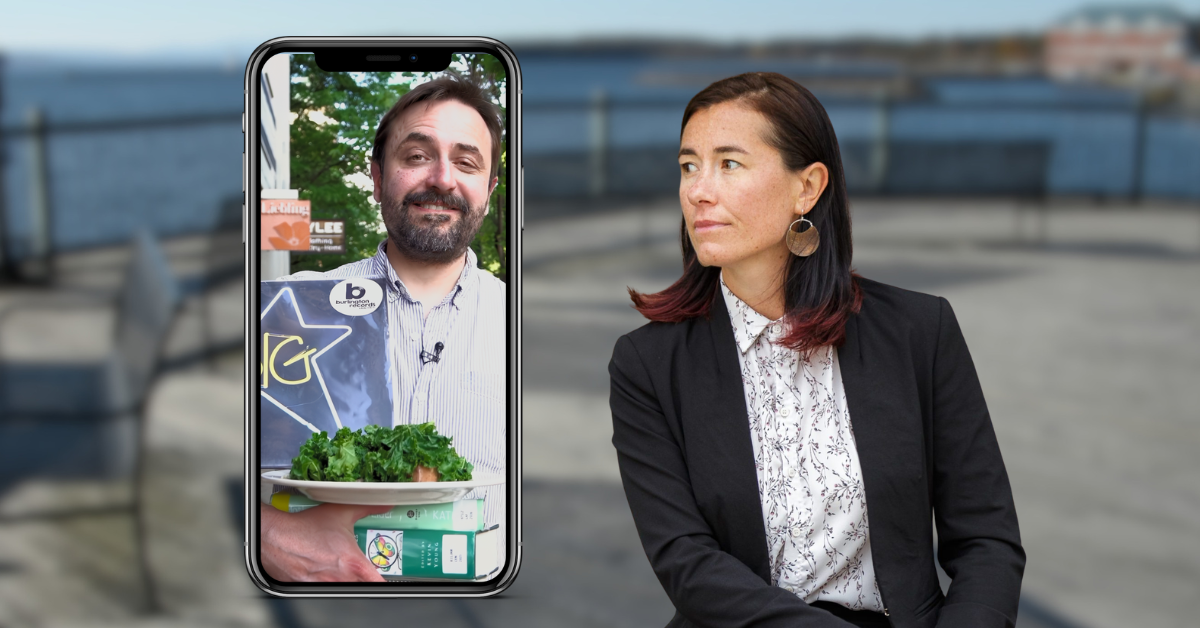
In what is likely his first and thus far only video ad of the cycle, Kranichfeld presents himself speaking directly to viewers in an informal style, filmed downtown, “I’m Bram, and I’m running for Chittenden County States Attorney,” he says.

“You know, I love Chittenden County, I love the community. I’ve been living here for 20 years and…I met my wife here, I’m raising my kids here, in the New North End. I love this community, it’s…tight knit, beautiful, occasionally quirky.” In the ad, Kranichfeld drops a few facts about himself and what he loves about Chittenden County, all while being handed random items from out-of-frame – a record, a coffee, some books.
Kranichfeld goes on to praise the county’s vibrant downtowns and their importance before closing with an appeal to vote on August 11 at the Democratic primary. Noticeably absent from the ad? Platform, or any type of policy.
Kranichfeld’s ad – seemingly – is attempting to snag that “folksy” feel so many candidates throughout Vermont want. This works, sometimes, but more often than not these very personal, sometimes funny, ads sacrifice policy (what a candidate will actually do) for personality (who a candidate purports themselves to be).
By contrast, Sarah George’s image advertisement on Facebook takes a clear, bullet-point approach, spotlighting common elements of her record. “As State’s Attorney, I’ve worked to make our justice system more effective, more fair, and more accountable,” the ad reads.
It highlights the expansion of the accountability court program that pairs repeat offenders with services, the resolution of roughly 700 backlogged cases from the 2020 court backlog through additional judicial resources, and her office’s defense of constitutional rights and civil liberties during the March 11 ICE protests, which the ad connects to protecting free speech and peaceful protest.
In addition to her policy-centered ad, George has continued to release her “Get Curious” series, where she has sought to dispel, what George says are, myths about her office and crime in the county.
George, who was appointed to the position in 2017 by Governor Phil Scott after serving as a deputy in the office since 2011, won election in 2018 and prevailed in a contested 2022 Democratic primary against a challenger supported by some law enforcement groups.
A recent public safety poll released earlier this month by Campaign for Vermont adds important texture to the contest. The survey of 512 likely Chittenden County voters found challenger Bram Kranichfeld leading incumbent Sarah George 35% to 20% in a head-to-head matchup, with a hefty 45% still undecided. On the surface, that looks like momentum for the underdog.
Dig deeper, however, and the numbers tell a more familiar story for Democratic primaries.
Among self-identified Democrats — the voters who will actually decide the August 11 primary — George leads Kranichfeld by 15 points. Kranichfeld’s overall advantage comes almost entirely from strong support among Independents and Republicans, groups far less likely to turn out in a low-profile summer Democratic primary.
The poll also underscores deep voter frustration with crime and public safety in Chittenden County. George, despite high name recognition (72% familiar), appears deeply underwater with non-Democrats on accountability issues.
Kranichfeld, though far less known, benefits from a general appetite for change.
However, Kranichfeld’s campaign is in a tough spot, strategically and electorally. His campaign has had to make the tough decisions of focus: to implicate George in something or to promote solely himself – staying away from criticizing George. While he has certainly released media about himself, what has been lacking, clearly by choice, is his campaign’s talking points on George. There are none, at least none the campaign has published.
George, on the other hand, has consistently made each race for the seat about her record, her work, her office, and her policy. Naturally, this is what an incumbent running for re-election does. But this year, much more so than 2022, George’s record and public messaging are strong. Given that strong status, Kranichfeld – over the next few weeks – must aim to present more contrast between him and George, if he wants a winning shot.

At the end of the day, both candidate’s campaigns share one common problem: the timeline of the August primary. Being that it is in August, many families are on vacation, or working and sending their kids to summer camp, and this has long presented a difficulty in primaries, especially where the candidate who gets the nod is almost guaranteed an election.
In practice, this typically means quite a low turn-out, where a small, politically-charged portion of the county will decide how laws are enforced upon or for everyone else in Chittenden.
At this stage in the campaign and with George’s name long in the media already, the time for persuading voters is over. Now, both campaigns should be focused on getting people out to vote, the hardest task of all. And this is where Kranichfeld’s odds take a hit.
The time for persuading and mobilizing voters, especially in Kranichfeld’s case, was months ago. It is likely he has missed a large swath of voters in the time since his announcement, where he hasn’t been hard on messaging, hasn’t been consistently engaging online, and, arguably, has had a dampened presence in Burlington since his departure from city politics nearly 13 years ago.
For Kranichfeld, now the focus is likely getting frustrated Democrats (who are already engaged) out to vote – but, it seems, there aren’t enough. There wasn’t enough in 2022 despite then-challanger Ted Kenney spending tens of thousands on outreach and engagement and, as the polls suggest, aren’t enough this year either.
Though more ads, money, and talking points are likely to come in the race, much can be read from what we currently can see from the candidates. And it doesn’t look good for the underdog.


Leave a Reply