
By Kolby LaMarche
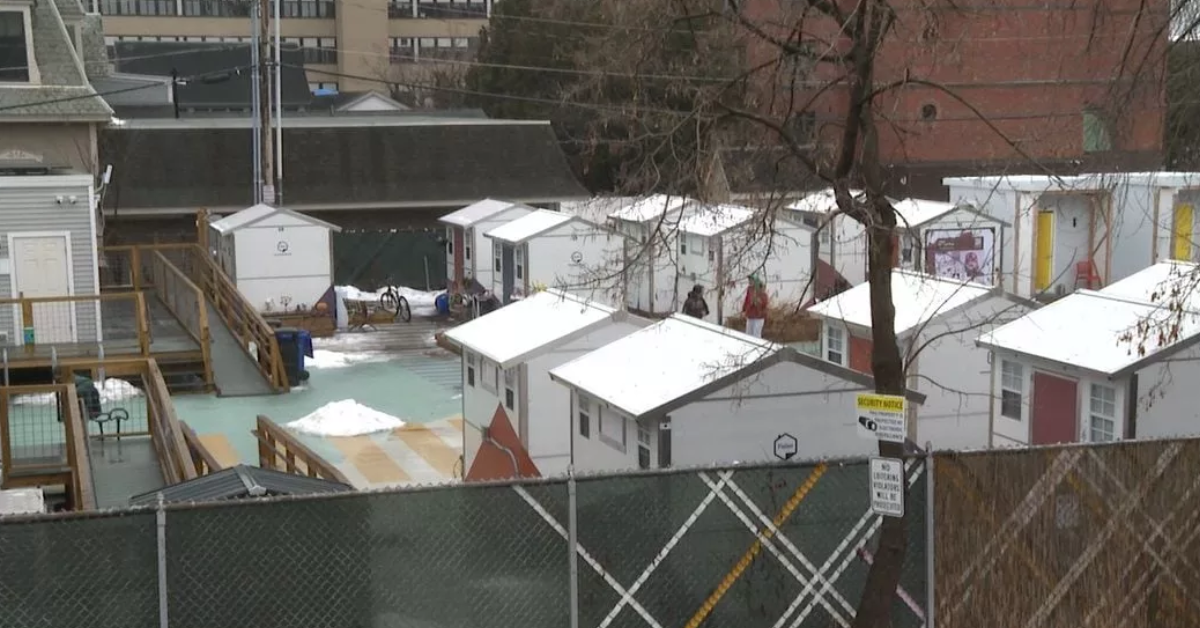
Managers from the Champlain Housing Trust (CHT) and the Champlain Valley Office of Economic Opportunity (CVOEO) announced last week that the Elmwood Community Shelter, a pilot project of modular housing units in the Old North End, will continue operating in some form, potentially transitioning to more enduring structures following a 10-year evaluation.
The decision comes amid Burlington’s escalating homelessness crisis, where the unsheltered population surged from 42 households in January 2023 to 252 by November of that year.
Originally launched as a temporary low-barrier emergency shelter, the pods have since housed dozens.
The project traces its roots to 2022, when city officials, grappling with the end of pandemic-era motel vouchers, sought innovative ways to address rising homelessness. The Burlington City Council approved the plan in March 2022, authorizing the use of a city-owned parking lot on Elmwood Avenue for the modular units.
Funded largely by state resources, the shelter opened in February 2023 with 25 single-occupancy pods—each roughly 64 square feet and equipped with basic amenities like electricity, heat, and air conditioning—alongside five double units, a community space, shared bathrooms, and laundry facilities.
Operated jointly by CHT and CVOEO, the low-barrier model imposed few entry restrictions, such as sobriety checks or background screenings, creating an environment which, they say, provided immediate refuge and pathways to permanent housing.
City representatives for long have framed the pods as a humane response to systemic shortcomings. Sarah Russell, formerly the City’s special advisor on homelessness, noted that in terms of success metrics “The goal of a shelter, an actual shelter, is to keep people sheltered until they move into permanent housing, so we measure success based on how long people can stay,” Russell said in 2023. “These folks aren’t the ones who have barriers. It’s our system that has barriers.”
Based on reporting from its first year of operation, the estimated annual operating cost of the pods is about $1.4 million. This figure covers staffing, security, maintenance, utilities, case management, and other expenses for the low-barrier shelter, which accommodates up to 35 guests.
Resident feedback since its inception has been largely positive, with former occupants describing their time as positive, safe, and helpful in their recovery or just to find shelter.
According to data, by March 2026, the shelter had served 149 guests with an average stay of 250 days. Of those, 19 secured stable housing, while 99 exited without permanent options, often returning to encampments or staying with acquaintances.
In the first year, 64 individuals across 55 households were housed, but of 32 exits by early December 2023, 25 were involuntary, and only two led to lasting homes.
However, while the initiative has helped some find housing or community, that hasn’t stopped criticism from neighbors and local stakeholders, who cite increased disorder and safety concerns tied to the low-barrier approach.
Early complaints in April 2023 included noise disturbances like yelling and fighting at odd hours, visible drug use just outside the pods, and discarded syringes on nearby properties.
O’Brien Brothers Properties, which oversees the nearby McKenzie House Apartments for seniors and low-income families, labeled the early period of the pods a “nightmare”, detailing incidents including staff assaults with weapons, drug-related blockages, property damage, overdoses, and thefts, claiming the city neglected promised oversight and forced his firm to allocate $40,000 yearly for private security.
“In my mind, it’s a dereliction of responsibility that the city has not put any resources towards what has clearly been a rise in bad behavior and criminal activity on all the adjacent properties,” a representative of O’Brien Bros. said at the time.
Operators, in years since, have responded by attributing many issues to external visitors rather than pod dwellers. CHT Director Michael Monte noted that collaborative meetings with Burlington Police prompted enhanced patrols to mitigate loitering and disturbances.
Police records indicate elevated service calls—382 in the second quarter of 2023, 475 in the third, and 274 in the fourth—around Elmwood Avenue, though officials contextualize these as consistent with area trends, where pre-2018 quarterly averages hovered near 400.
In Burlington, access to Section 8 Housing Choice Vouchers remains challenging due to high demand and limited funding – a problem dating back much further than a decade. The Burlington Housing Authority (BHA) manages the program locally, reporting wait times for assistance that can exceed five years, with additional waits of two to four years for suitable properties.
Statewide, the Vermont State Housing Authority (VSHA) closed its Housing Choice Voucher waitlist on January 31, 2025, after pausing new issuances in May 2025 amid lengthy backlogs and budget shortfalls.
As of early 2026, the waitlist remains closed, with Vermont households averaging 14 months on lists before receiving vouchers, though local figures in Chittenden County often stretch longer due to housing shortages.
In 2025, a pilot for overnight vehicle parking at Perkins Pier was announced but paused indefinitely due to community concerns. As of March 2026, no new allowances have been formalized, but discussions continue on expanding safe spaces.

Leave a Reply