
By Kolby LaMarche
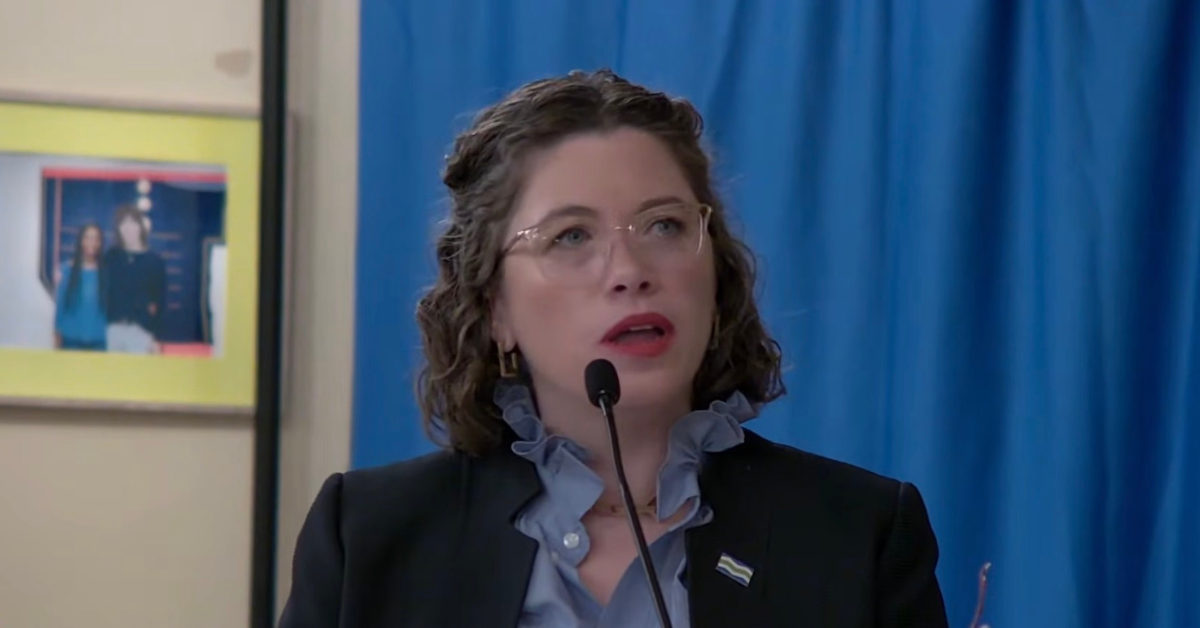
Mayor Emma Mulvaney-Stanak delivered her third and final State of the City address of her first term Monday night, emphasizing signs of progress in public safety and city operations while acknowledging persistent budget pressures, housing shortages and social challenges.
Speaking to a small crowd of residents, officials, and council members in Contois Auditorium at City Hall, the Progressive mayor described a city showing “momentum” after years of post-pandemic strain and waves of crime.
The address took place during the annual city government organization meeting, which included the swearing-in of new councilors and the re-election of Ben Traverse as council president on a 7-5 party-line vote. The Progressive candidate to become president, who ran the year prior, failed.
“This is really Burlington at its best,” Mulvaney-Stanak said.
Mulvaney-Stanak, who became Burlington’s first woman and first openly LGBT mayor in 2024, used the roughly 30-minute speech to outline her administration’s efforts on public safety, housing, finances and infrastructure. She called for greater unity among city leaders after two years marked by partisan tensions on the council.
On public safety, the mayor pointed to recent data showing improvement. “Violent crime has declined to levels we haven’t seen since 2021,” she said.
She highlighted increased foot patrols, a city-led “situation table” for crisis response, expanded partnerships with the Howard Center for mental health services, and collaboration with Gov. Phil Scott and Chittenden County State’s Attorney Sarah George on an accountability court aimed at reducing recidivism.
Mulvaney-Stanak credited interim Police Chief Shawn Burke and stressed a balanced strategy combining enforcement with outreach.
She described the city’s challenges as a “trifecta” of homelessness, mental health needs and substance use issues, compounded by a housing shortage and affordability crisis, plus lingering pandemic effects on young people.
Housing remained a major theme, though details were still light.
The mayor noted the merger of the Community and Economic Development Office with the Office of City Planning to accelerate project approvals. “This past year, we brought together two core departments, our Community Economic Development Office, or CDO, and our Office of City Planning, so that we can innovate faster and move more effectively on housing,” she said.
Other initiatives include a new “housing shepherd” role, inclusionary zoning updates, expansion of the Housing Trust Fund, and identification of underutilized city-owned land for redevelopment. The city continues to pursue the South End Coordinated Redevelopment Project and aims for long-term goals such as adding thousands of new housing units. Collaboration with the University of Vermont on student housing was also referenced in broader city planning discussions.
Financially, Mulvaney-Stanak noted that difficult decisions in recent budgets have helped stabilize operations.
The administration continues to manage structural budget gaps. The city faced an approximately $8 million shortfall earlier in the 2026 budget process, addressed through position reductions and other measures, and is projecting another multimillion-dollar gap for the upcoming fiscal year. In her speech, she asked departments to, essentially, hold tight as the city navigates its finances.
The mayor has described these recurring deficits as structural, stemming from expenses consistently outpacing revenues even without unexpected crises. Her administration has advanced the budget timeline to avoid last-minute disruptions.
Infrastructure highlights included upcoming completions on the Champlain Parkway and Main Street projects, wastewater system upgrades funded by a voter-approved bond, and the opening of the new Burlington High School in the fall.
The mayor also discussed climate resilience efforts, including work to address cyanobacteria blooms in Lake Champlain and plans for a new water park to provide cooling alternatives on days when lake swimming is restricted. The mayor did not share any updates on a plan to dredge the lake-front.
While all-around claps and cheers occurred, council reaction nonetheless reflected ongoing divisions.
Traverse, a Democrat, was re-elected council president over a Progressive challenger in a party-line vote. Newly sworn-in councilors included Laura Sánchez-Parkinson, noted as the first Latina to serve on the body.
At the same time, residents continue to voice concerns over high housing costs, the visible impacts of homelessness and untreated mental health or substance use issues in some neighborhoods, and the cumulative effect of recent tax and service adjustments.
Working families and younger residents particularly feel the squeeze of affordability challenges and question “who” the mayor’s policies will benefit, especially as it relates to new housing.
The mayor’s message Monday framed the city as at a “generational” turning point where sustained investment and collaboration could yield lasting results.
With her first term winding down, the test ahead will be whether the momentum she described can translate into broader relief on the core issues of safety, housing and fiscal stability that Burlington residents confront daily.
The next regular session is scheduled for April 13.

Leave a Reply