
By Kolby LaMarche
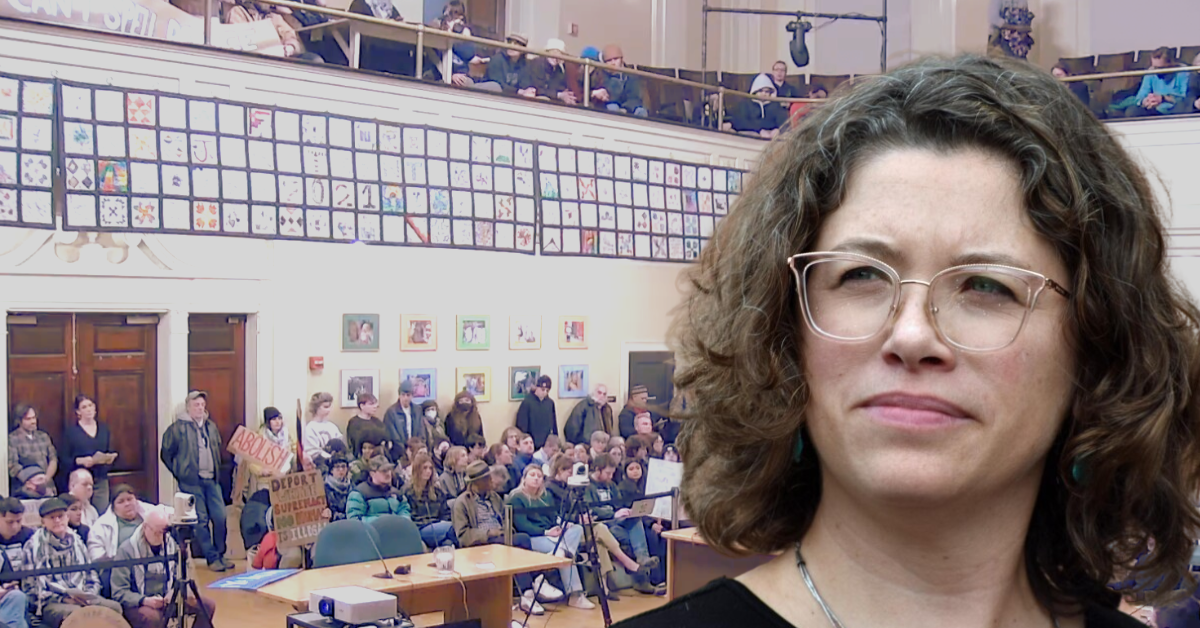
Nearly 100 residents packed Burlington City Hall on Monday night for a City Council meeting that stretched late into the evening, turning public comment into a raw airing of grievances over the Burlington Police Department’s role in a March 11 Immigration and Customs Enforcement operation in neighboring South Burlington.
The session followed an executive session that began at 5:45 p.m., where councilors likely discussed the department’s assistance to South Burlington police during the federal raid on a Dorset Street home.
That action ended with three immigrant Vermonters detained, a chaotic chase through morning rush-hour traffic and clashes that drew hundreds of protesters back to the streets two days later in Burlington.
What began as a routine agenda item quickly became, again, a test of the council’s decorum — and the mayor’s political maneuverability.
Council President Ben Traverse, a Democrat representing Ward 5, opened the public-comment portion with the standard two-minute limit per speaker. He quickly abandoned strict enforcement.
Dozens of residents exceeded the time, some by several minutes, as Traverse offered little more than occasional reminders to stay on topic and on time.
When speakers directed profanity at the dais or the public-comment table itself, he interjected sparingly, “f*ck the patriarchy” one speaker shouted, uninterrupted, before exiting.
The approach echoed the largely unmoderated public-comment periods that marked City Council meetings in 2020, when pandemic restrictions and racial-justice protests saw rules relaxed to accommodate raw community anger. Something very similar, seemingly, happened here by Traverse.
Democrat Evan Litwin, Ward 7, rose at one point to raise a point of order, noting that the outbursts and extended speeches were testing the bounds of council procedure.
Traverse acknowledged the objection but allowed the flow to continue, drawing scattered applause from the crowd and apparent quiet frustration from some councilors.
One speaker who identified himself as having been at the March 11 protest stepped to the microphone and declared, without hesitation, “We were violent and we had every right to be.”
Several others followed with similar intensity, accusing the city of complicity in federal immigration enforcement and demanding accountability for any Burlington officers who deployed less-lethal munitions or helped contain the crowd.
Many shared their experiences of that day – being there, seeing Burlington police, and attempting to protect what they called their “vulnerable” neighbors. From those experiences, speakers offered advice for the future: amend the city’s Fair and Impartial Policing ordinance, use BPD as a force to stop ICE enforcement actions, and for citizens to “have the right to fire officers.”
Not every voice called for drastic measures. A handful of speakers thanked police for maintaining order under difficult conditions and urged the council not to hamstring local law enforcement in future multi-agency responses. Others, too, shared that no matter what the City does, ICE will continue the work they have been directed to do.

But the dominant thread was frustration aimed squarely at Progressive Mayor Emma Mulvaney-Stanak and the larger Burlington municipal government.
At least a few residents called for her resignation, citing her defense of the department’s assistance to South Burlington police and what they described as insufficient condemnation of the ICE action. “She stood with the cops instead of the community,” one speaker said.
Others accused her of shielding a morale-deprived, but improving, department while ignoring the voices that helped elect her.
Seated front and center in the audience was Progressive state Rep. Brian Cina of Burlington.
He clapped enthusiastically for nearly every criticism of police tactics and federal overreach.
When calls for the mayor’s resignation arose, however, his hands stayed still. He shifted in his seat and glanced around the room with visible unease each time the demand surfaced, before turning again to a cheerful support.
This was one of the more revealing facts of the night: Progressives are very divided on how to hold Mayor Mulvaney-Stanak accountable, if they even want to hold her to any account.
Mulvaney-Stanak and Police Chief Shawn Burke repeated positions they had staked out days earlier. The mayor read from notes that closely tracked her March 12 public statement, in which she called the South Burlington events “deeply disturbing” and acknowledged that federal agents’ tactics escalated tensions.
She reiterated that “there are real limits to local control in these situations, but that does not lessen our responsibility to examine our own actions, to be transparent and to make improvements.” Burke, for his part, defended his officers’ decision to provide mutual aid, emphasizing that the request came from a neighboring department facing an unfolding situation.
For Mulvaney-Stanak, the evening crystallized a bind she has described for months. In interviews and statements dating back to last year, she has repeatedly noted that the job of mayor in a city like Burlington is often “impossible.”
Monday’s meeting appeared to prove the point.
Progressive activists who form a core part of her base demanded she denounce the police role more forcefully. At the same time, city officials face real constraints when federal agents or neighboring departments request assistance during emergencies.
Bashing the department risks alienating officers already under scrutiny; placating the loudest progressive voices risks alienating moderates who expect steady governance.
In an apparent effort to ease the immediate outrage, Mulvaney-Stanak announced that the city will hold a public forum hearing to hear directly from residents impacted by the March 11 events.
The session, she said, will focus on any policy or procedural changes needed to prevent a repetition of that event. Details on exact timing and format will be released in coming days, she added.
The meeting adjourned well after 10 p.m. No formal votes were taken on the ICE matter, though several councilors signaled they would pursue further oversight.
For now, much of the evidence – body cameras, reports, interviews, etc – will remain sealed as both the Burlington Police, South Burl. Police, VT State Police, and federal partners – like the FBI – investigate the conduct of their officers and agents, and the actions of the protestors.
BDN will provide updates as the harm hearing approaches.


Leave a Reply