
By Kolby LaMarche
Burlington’s Department of Public Works (DPW) has identified a $16.6 million funding shortfall for the Reconnecting Bank & Cherry project, according to a memo presented to the City Council last night.
The latest construction cost estimate totals approximately $48 million. This covers restoring the downtown street grid by building new segments of St. Paul and Pine streets through the former CityPlace mall site to reconnect Bank and Cherry streets, plus streetscape upgrades to existing sections of Bank and Cherry streets, the city said.
However, now, the city has about $31 million in secured funding.
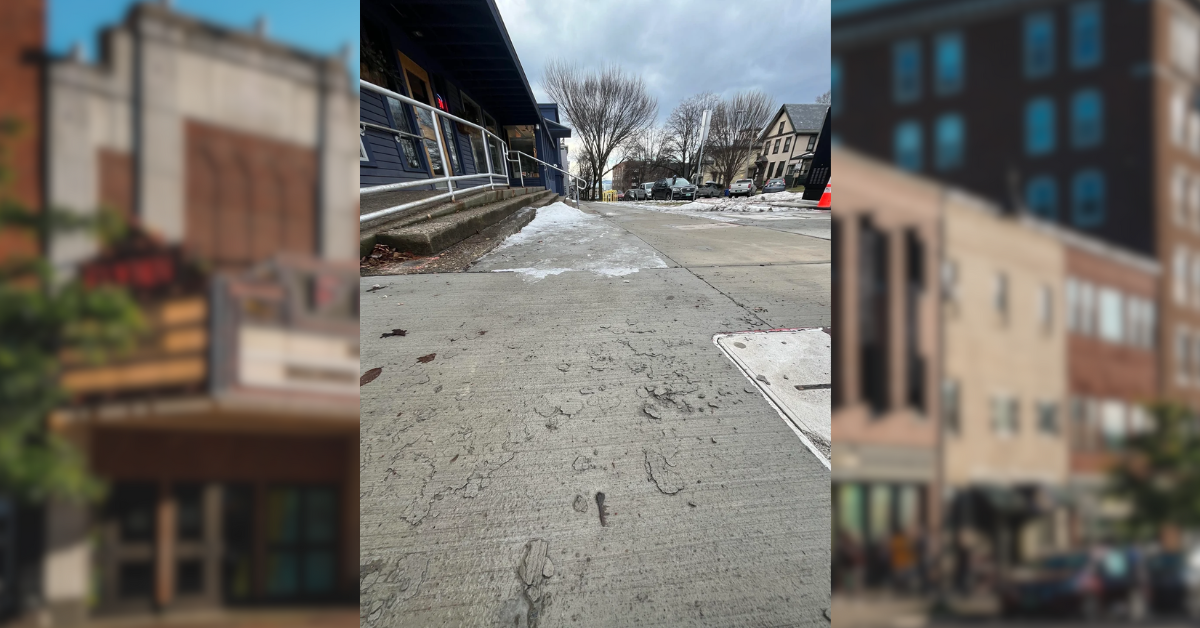
To add to the problems: sidewalks on Main Street and northern Pine Street were recently completed by the city to expand the sidewalks and allow greater pedestrian movement.
As of this week, the sidewalks have begun to crumble. According to best practices, new sidewalks should not be salted for the first year of their use, due to the aggressive way road salts can eat away at freshly laid sidewalks.
This includes a $22.3 million federal RAISE grant awarded in 2023, roughly $12 million in congressionally directed spending secured earlier by former Sen. Patrick Leahy, and about $22 million in Tax Increment Financing (TIF) bonds approved by voters in 2016.
The TIF uses new property tax revenue generated from the CityPlace redevelopment to repay debt for public infrastructure like these streets.
The gap emerged because costs rose significantly since earlier projections around $31 million. City officials, including Democrat President Ben Traverse, blamed the shortfall on Inflation since 2023 and higher prices for materials.
Typical industry inflation might have added $4-6 million over three years, according to financial data. The remaining gap reflects real, localized pressures like scarce workers demanding higher pay, tariff-driven material hikes, and bid realities.
Leaders say the project budget was set years ago based on then-current prices. Construction costs nationwide — and in Vermont — have climbed sharply due to economic factors after the pandemic.
DPW’s primary recommendation is to phase the project to fit available funds. Phase 1 would prioritize Cherry Street upgrades and the new St. Paul and Pine street extensions to restore connectivity through the mall site first.
Bank Street upgrades would be delayed to a later phase, potentially saving about $15 million upfront.
Other options include pursuing additional grants, such as up to $15 million in new Congressionally Directed Spending expected in June, or adjusting existing TIF arrangements.
The project builds on the Great Streets standards seen in completed work on lower St. Paul and Main streets, with wider sidewalks, protected bike lanes, stormwater features like rain gardens, street trees, improved lighting, and better access for pedestrians, cyclists, and transit.
Public input on designs occurred in 2024, and earlier plans targeted Cherry Street groundbreaking in 2026, with Bank Street to follow. No new timeline has been finalized, and bids could go out later this year for a possible 2027 construction start.
Burlington has faced broader budget pressures in recent years, including multimillion-dollar general fund shortfalls in 2024 and 2025 due to expiring federal aid and inflation, city departments say. This project-specific gap is separate but reflects similar cost challenges.
DPW describes the reconnection as a priority for improving downtown safety, walkability, and economic activity after decades of disruption from 1960s urban renewal and the old mall.
Leave a Reply