
By Kolby LaMarche
In a bold move toward greener energy, the Burlington Electric Department (BED) has unveiled a groundbreaking study on retrofitting its flagship McNeil Generating Station with wood pyrolysis technology.
The report, released this week by third-party consultant Velerity, outlines a path to double the plant’s electricity generation efficiency while slashing carbon emissions by up to 79%, all without hiking rates for customers, the city says.
For a city already boasting 100% renewable power, the proposal could redefine biomass energy’s role in Burlington’s long-running climate fight, seeking to answer some critics who have decried the facility as a “climate disaster.”
The Joseph C. McNeil Generating Station, a 50-megawatt wood-fired behemoth in Burlington’s Intervale neighborhood, has powered the Queen City since 1984.
Jointly owned by BED (50%), Green Mountain Power (31%), and the Vermont Public Power Supply Authority (19%), it burns about 141,504 tons of sustainably harvested wood chips annually to generate 104,206 megawatt-hours (MWh) of electricity—roughly one-third of Burlington’s needs.
But at just 24% efficiency, much of the energy is lost as waste heat, and the plant’s stack emissions—141,720 tons of CO2 equivalent per year—making it Vermont’s largest single-point carbon source. Activists from groups like Stop VT Biomass have rallied against it, labeling the facility a “carbon bomb” that undermines the state’s net-zero ambitions.
Enter the city’s answer: wood pyrolysis, a high-temperature, oxygen-free thermal process that decomposes wood chips into syngas for electricity and biochar as a carbon-rich byproduct.
Unlike traditional combustion, pyrolysis avoids direct CO2 release during decomposition. The syngas fuels a combined-cycle turbine—combustion followed by steam recovery—yielding up to 60% efficiency, nearly triple McNeil’s current output per unit of wood. Biochar, locked with stable carbon, can be sold as a soil amendment for agriculture, sequestering emissions long-term.
The Velerity study, commissioned via a 2023 City Council resolution, projects three pyrolysis systems at McNeil producing 100,034 MWh annually—49% of total output—while consuming 75,000 tons of wood yearly.
Carbon intensity drops to 0.40 tons of CO2 per ton of wood, versus 1.00 for combustion, yielding just 30,046 tons of emissions overall—a 79% reduction site-wide. Amongst all the numbers, “This is a win-win,” said BED General Manager Darren Springer in a statement. “We address environmental concerns while preserving reliability and affordability for ratepayers, especially low- and moderate-income households.”

Financially, it’s even more compelling, the department said. The retrofit’s net revenue requirements fall by $618,037 annually, thanks to $6 million in McNeil wood cost savings offsetting pyrolysis fuel hikes and biochar sales.
With BED’s average rate at 17.34 cents per kilowatt-hour and $56.7 million in yearly revenues from 327,126 MWh sales, the implied rate dips to 17.16 cents—a 1.09% decrease.
Capital costs of $2.07 million for pyrolysis infrastructure are front-loaded, but operations promise steady gains. NOx emissions from syngas combustion would feed into McNeil’s existing capture system, meeting EPA standards.
Prompted by council directives, the report also models a McNeil-free future to benchmark alternatives. Shutting down the plant would spike BED’s revenue needs by 17%, adding $1.1 million in wholesale power premiums and $595,000 in renewable energy credits (RECs) to “green” fossil-heavy ISO-New England grid buys.
The pyrolysis hybrid leans on on-site upgrades, including battery storage already eyed for McNeil’s solar test center. Hydro emphasizes out-of-basin purchases, but both prioritize affordability—crucial as electrification incentives hinge on BED’s renewable badge.
McNeil, the city asserts, injects millions into Vermont’s wood economy via jobs in harvesting, rail transport from Swanton, and maintenance for 40 staff. A third-party analysis by Innovative Natural Resource Solutions said it boosts regional forest carbon sequestration by favoring sustainable thinnings over development.
Yet efficiency upgrades have eluded the plant for decades; six district energy studies since the 1980s fizzled, including stalled steam pipes to the University of Vermont Medical Center.
The Velerity report nods to other tweaks: ammonia additives for capture or renewable gas co-firing, though these risk the renewable designation. Springer emphasized community input: “We’re evaluating these technologies collaboratively, building on our UVM solar and hydroponics pilots at McNeil.”
Critics remain wary, though, and they say pyrolysis isn’t what it is hyped up to be, citing a recent Vermont Climate Council study. Health advocates flag particulates downwind in Winooski and Burlington’s Old North End, urging air monitoring.
As winter peaks loom, BED pushes for ownership transfer from partners to streamline upgrades.
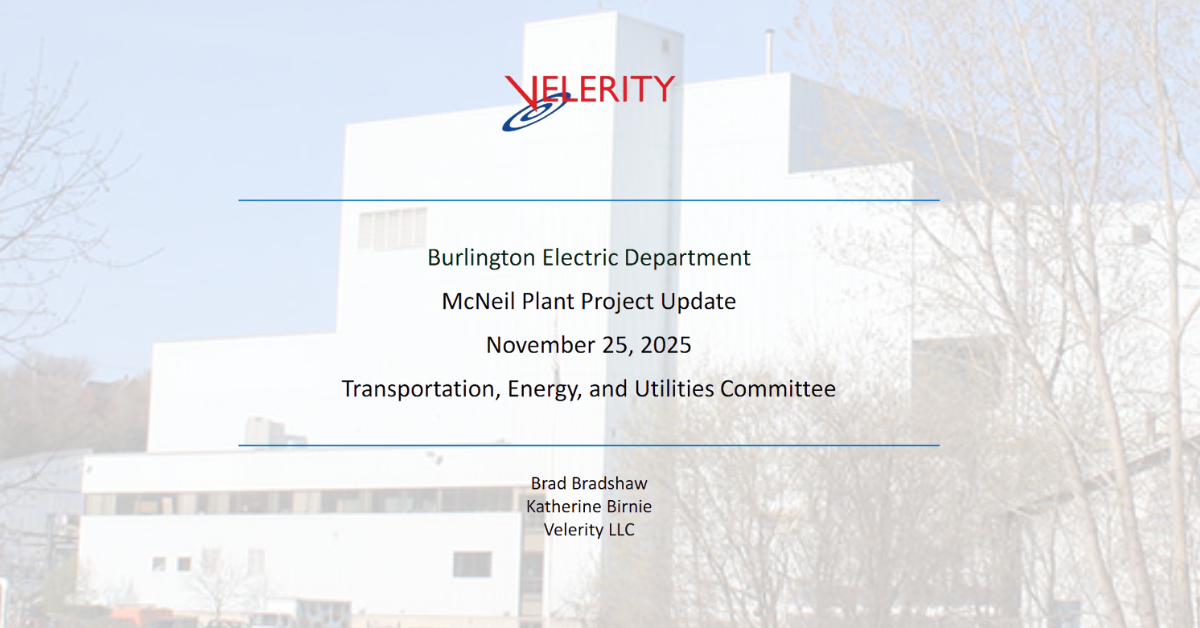
The Transportation, Energy, and Utilities Committee will review the report Tuesday, with public hearings ahead.
Leave a Reply